Showing posts with label USA. Show all posts

Tuesday, 19 April 2016

Supreme Court asks whether Obama overreached with immigration program

President Obama announces his expansive executive actions on immigration in 2014. (Photo: Jim Bourg, Pool/AP)

The Supreme Court’s conservatives, led by Chief Justice John Roberts, seemed skeptical Monday of President Obama’s sweeping immigration executive actions that would shield 4.5 million unauthorized immigrants from deportation and make them eligible for work permits.

Two lower courts ruled that the “deferred action” programs were unconstitutional, and prevented them from being implemented pending the Supreme Court’s decision. The court, which lost its conservative firebrand Antonin Scalia in February, has been mostly kind to the president’s legacy — but it’s unclear if his luck will hold out in his final year in office.

In oral arguments in the case, Roberts asked Solicitor General Donald Verrilli to explain whether he believed a president could decide not to deport any immigrants at all. Verrilli said immigration law binds the executive to deport immigrants recently arrived at the border and those who commit crimes, but he stressed that Obama’s program, which is aimed at young unauthorized immigrants and the parents of U.S. citizens, is not that sweeping. “That’s a million miles from where we are now,” Verrilli said.

“It’s 4 million people from where we are now,” interrupted Justice Anthony Kennedy, one of the court’s conservatives who occasionally sides with the liberals. Kennedy added that he thinks the president is setting policy on his own, ignoring the will of Congress. “That’s just upside down,” he protested.

Both Roberts and Kennedy sided with the court’s liberals in the last major immigration case to reach the Supreme Court, over Arizona’s SB 1070 law. They affirmed the executive’s power to pursue its own immigration policies even when it inconveniences states.

But in Monday’s oral argument, both men asked questions that suggested they believe this case is different. If the court rules against the government, it could put in jeopardy Obama’s earlier program that has already protected from deportation 800,000 young unauthorized immigrants who came to the country as children. That deferred action program is not being challenged, but if the court issues a broad ruling, it may undercut its status as well

Mario Gochez of New Jersey joins other supporters of immigration reform in front of the Supreme Court, April 18, 2016. (Photo: Pablo Martinez Monsivais/AP)

Verrilli maintained that Texas and 25 other states that joined its claim do not have the legal right, or standing, to sue the federal government. Texas is suing because the state allows people with deferred action status to apply for driver’s licenses. The state estimates it would spend millions of dollars if the estimated 500,000 people in its state who will be legalized under Obama’s programs apply for licenses.

The government says Texas could easily change its law, preventing people on deferred action from getting licenses. But Roberts and Justice Samuel Alito seemed to reject that argument, pointing out the government would probably sue Texas if it blocked immigrants from accessing licenses. Verrilli would not rule out that possibility, but maintained the state still did not have standing.

Justice Stephen Breyer made the most convincing argument for not granting Texas standing — a decision that would allow the eight-person court to dodge a contentious deadlock on a politically charged case. The liberal judge said the Supreme Court had already decided that states and taxpayers may not bring suits against the federal government simply because they do not believe their taxpayer money should be spent on policies they do not agree with. Allowing such suits to continue would make courts the referees in non-Constitutional disputes between states and the feds. “Before you know it, power will be transferred from the president and Congress, where it belongs, to a group of unelected judges,” Breyer said.

It’s unclear whether Breyer’s argument will sway his colleagues. In 2007, the court’s liberals allowed Massachusetts’ residents to sue the Environmental Protection Agency over its failure to enforce carbon emissions rules, which they argued was leading to the erosion of the state’s coastline. Breyer argued that case was different, because it involved the state’s land, not simply its taxpayer funds. At one point on Monday, Roberts said that the loss of the state’s money is “classic” injury, suggesting he may not share Breyer’s hesitation on standing.

It’s not just the fate of millions of immigrants that hang in the balance. If the court strikes down the president’s immigration actions, it will be a reversal of recent trends. “Historically, immigration is an area where the Supreme Court has given the president a whole lot of deference,” said Jeff Rosen, president of the nonprofit National Constitution Center. If the court decides Obama overreached, “that will be a really dramatic holding.”

A decision is expected in June.

Source: https://www.yahoo.com/news/supreme-court-asks-whether-obama-overreached-with-173151507.html

Thursday, 7 April 2016

US authorities arrest 21 people involved in visa scam through fake college trap

University of Northern New Jersey was set up to lure criminals who defrauded over 1,000 foreigners, who now face deportation, in ‘pay to stay’ enterprises

university of northern new jersey fake college immigration scam
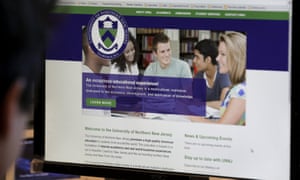
 The website for University of Northern New Jersey, a phony university set up by US government to lure criminal who defraud student and exchange visitor program. Photograph: Brendan Mcdermid/Reuters
The US government set up a bogus college called the University of Northern New Jersey as a trap to arrest 21 people on charges they conspired to help more than 1,000 foreigners fraudulently keep or obtain student or work visas over the past 2½ years.
Now those overseas students face being deported from the United States for buying visas, in an alleged immigration scam worth up to $1m.
“They were all willing participants in this sophisticated scheme from the very beginning,” Will Skaggs, a spokesman for the US attorney’s office for New Jersey, said on Wednesday.
Federal agents created the fake University of Northern New Jersey more than two years ago and on Tuesday arrested 21 middlemen who operated from coast to coast running “pay to stay” enterprises that foreign students used to remain in America beyond their allotted legal study time.
The 21 have made initial appearances in court and are expected to be arraigned in federal court in Newark at a later date still to be scheduled, to face charges that include conspiracy to commit visa fraud and conspiracy to harbor aliens for profit.
Those arrested were mostly brokers who recruited foreign students, who were mainly from China and India and knew they were signing up for a university that was fake, according to the authorities, though not that it had been invented by federal agents in order to expose the scam.
The middlemen promised them study visas and visa extensions or foreign worker visas in a system of fees and kickbacks that netted the brokers as much as $1,000 per student, according to the US attorney’s office.
Further, some of the students used the visas issued through the bogus scheme to get jobs at companies such as Apple, Facebook and Morgan Stanley, as well as one who joined the US army, according to a report in the New York Times.
The students will not face further punishment beyond being thrown out of the country. But the middlemen who were arrested face potential maximum punishments of 10 years in prison.
In addition to brokers, the 21 defendants include recruiters and employers, both men and women, from a variety of locations in the states of New York, California, Georgia, Illinois and New Jersey.
Paul Fishman, US attorney for New Jersey, announced the arrests in Newark on Tuesday and said that the government had originally established the facade of the University of Northern New Jersey in September 2013.
He said the sting exposed the type of alleged criminal scheme that threatened not only the legitimate visa system but US national security.
The defendants had not conducted background checks on their student clients, the authorities said, although the individuals would have originally been screened by the government in order to enter the US in the first place.
The Departments of Homeland Security and Immigration and Customs Enforcement conducted the investigation and set up undercover agents to pose as staff at the fake university, which had its own website.
The UNNJ presented itself as a for-profit college located in Cranford, New Jersey.
“They did not even need to solicit anyone, the brokers came to them, bringing in students – who were looking for people to help them stay in the country,” said Skaggs.
The middlemen appeared to have years of experience and are alleged to have facilitated the creation of false student records and diplomas, “which were purchased by their foreign national conspirators for the purpose of deceiving the immigration authorities”, a statement from Fishman’s office said.
“This was not their first rodeo, as it were,” Skaggs said.

Source: http://www.theguardian.com/us-news/2016/apr/06/fake-college-visa-scam-immigration-arrests-university-northern-new-jersey

Wednesday, 16 March 2016

L-1 and H-1B visa extensions delayed at USCIS:

US Citizenship and Immigration Service (USCIS) centers are struggling to processL-1 visa (both L-1A and L-1B visas) petition extensions and H-1B visa extension applications, resulting in severe delays. In this situation it may be advisable to pay the additional Government fee of US$1225 and use premium processing. An 'overwhelming backlog' is said to be the cause, however, USCIS has not publicly disclosed why delays have occurred and have not yet provided any explanation for the backlog.

Tuesday, 15 March 2016

Woman Charged With H1B Visa Fraud In US

Woman Charged With H1B Visa Fraud In US
In all cases, the accused demanded and took illegal payments from victims in exchange for purportedly filing H-1B visa applications on their behalf, federal prosecutors alleged.
NEW YORK:  A woman in the US has been arrested on charges of H-1B visa fraud for luring foreigners seeking work in the US with nonexistent jobs and charging them unnecessary visa fee.

Raina Massey, the head of Newark-based Care Worldwide (CWW), is facing charges of wire fraud, visa fraud and identity theft after she allegedly conducted a multifaceted immigration scheme from February 2012 to March 2015, federal authorities said.

She was arrested yesterday.
According to federal prosecutors, from February 2012 through March 2015, Ms Massey and others executed the fraud scheme through her company, which purported to be a clinical research company, but was actually a shell company that did little to no legitimate work of any kind.

Ms Massey and others sought out and advertised for qualified foreign professionals, purportedly to work for CWW in clinical research positions as beneficiaries of H-1B visas.

These beneficiaries became victims of the scheme because the advertised positions did not actually exist.

For one set of victims, Ms Massey engaged in "benching", a form of fraud in which she and others falsely represented that the beneficiaries would have speciality technical jobs waiting for them upon their arrival at CWW.

After taking illegal payments from these beneficiaries, Ms Massey and others then completed applications for H-1B visas for these beneficiaries. However, when the beneficiaries arrived in the United States, Ms Massey and others employed them in menial tasks, such as handing out fliers on street corners.

For a second set of victims, Ms Massey and others, after illegally taking payments from the victims, never actually applied for H-1B visas. She and others provided these victims with false and fraudulent Form I-797Cs, which contained receipt numbers from other, previously filed, H-1B visa applications.

For a third set of victims, Ms Massey and others, after illegally taking payments from the victims based on fraudulent representations regarding H-1B visas, never provided any documentation whatsoever to the victims.

In all cases, Ms Massey and others demanded and took illegal payments from victims in exchange for purportedly filing H-1B visa applications on behalf of the victims, federal prosecutors alleged.
Source: http://www.ndtv.com/world-news/woman-charged-with-h1b-visa-fraud-in-us-1287372

New US visa rules for international students

NEW YORK: The United States federal government changed rules for non-immigrant student visas on Friday, saying that international students will now be eligible to stay for three years after finishing their degrees for training potentially leading to employment.
Only students earning degrees in science, technology, engineering and mathematics (STEM) fields from accredited higher education institutes and employed by employers participating in E-Verify are eligible for the optional practical training (OPT) program.
The new rule is seven months longer than the previous 17 month rule and comes into effect on May 10, 2016. The extension is also meant to widen the window of time to match fresh graduates with employers looking for skilled talented workers.
Previously, students had to apply for a visa known as H-1B, given by lottery and capped at 65,000 with 20,000 reserved for those with advanced degrees.
The extension was met with a mixed response even before it was published as immigration reform and unemployment remain hot topics in the US and wage protections are just one measure the ruling includes for both international STEM OPT students and permanent American workers.
According to the new rules, “a STEM OPT student would not replace a full- or part-time, temporary or permanent US worker,” and that the salary offered would “be commensurate” to American workers.

Source: http://www.dawn.com/news/1245226

Monday, 1 June 2015

13 companies barred from applying for H-1B visa

Like past two years, this year too US Citizenship and Immigration Services, the federal agency that processes H-1B applications, reached the cap for H-1B work visas for 2016 within the first five days.

The huge number of applications show the massive demand for these visas. But it's increasingly getting tougher to get a work visa each year. For, these visas are often blamed for rising unemployment in the US.

Past many years have also seen bills being introduced in the US that attempt to penalise -- in some way or the other -- the companies using these visas.

There has also been a rise in the rejection rate of H-1B visa applications filed by companies. Below is the list of companies that have been debarred/disqualified from applying for H-1B visa.

1. Advanced Professional Marketing Inc

June 01,2015
Advanced Professional Marketing Inc


 Address: 229 East 21st Street, New York, NY 10010

Employer willful violator: Yes

Debarment period: 8/1/2014 to 7/31/2015

2. Amreli Technology Solutions LLC

June 01,2015
Amreli Technology Solutions LLC


Address: 17530 NE Union Hill Rd. Redmond, WA 98052

Employer willful violator: Yes

Debarment period: 1/31/2014 to 1/30/2016

3. ASAP America, LLC d/b/a ASAP America

June 01,2015
ASAP America, LLC d/b/a ASAP America


Address: 1501 US Highway 441
 
Employer willful violator: Yes

Debarment period: 7/31/2013 to 7/30/2015

4. digiBlitz Technologies Pvt Ltd

June 01,2015
digiBlitz Technologies Pvt Ltd


Address: 3976 University Drive Suite 350Fairfax, VA 20300

Employer willful violator: NO

Debarment period: 10/1/2014 to 9/30/2015

5. DTP, LLC d/b/a Digital Transaction Processing

June 01,2015
DTP, LLC d/b/a Digital Transaction Processing


Address: 16000 Christensen Road, Suite 130, Seattle, WA 98188

Employer willful violator: YES

Debarment period: 12/10/2013 to 12/9/2015

6. Gunderson Sweetwater

June 01,2015
Gunderson Sweetwater
 
 
Address: 8410 W. Thomas Road, Bldg. 4, Suite 138, Phoenix, AZ 85037

Employer willful violator: YES

Debarment period: 10/1/2014 to 9/30/2016

7. Jai Mataji, LLC

June 01,2015
Jai Mataji, LLC
Address: 1206 Piedmount Hwy., Cedartown, GA 30125

Employer willful violator: YES

Debarment period: 10/29/2013 to 10/28/2015

8. Life Nutritionales LLC

June 01,2015
Life Nutritionales LLC


Address: 1501 US Highway 441, North, Suite 1706, The Villages, FL 32159

Employer willful violator: YES

Debarment period: 7/31/2013 to 7/30/2015

9. Marathon Health Care Corporation

June 01,2015
Marathon Health Care Corporation


Address: 443 Winthrop Street, Basement, Unit 4B Brooklyn, NY 11203

Employer willful violator: NO

Debarment period: 9/1/2014 to 6/31/2015

10. RMJM Group Inc

June 01,2015
RMJM Group Inc


Address: 132 W. 31st Street, 6th Floor, New York, NY 10001

Employer willful violator: YES

Debarment period: 10/1/2014 to 9/30/2016

11. Rudell & Associates, Inc

June 01,2015
Rudell & Associates, Inc


Address: 11-11 40th Avenue, Long Island City, NY 11101

Employer willful violator: YES

Debarment period: 10/29/2013 to 10/28/2015

12. Supreme Tech Solutions, LLC (Krios Technology Group LLC)

June 01,2015
Supreme Tech Solutions, LLC (Krios Technology Group LLC)


Address: 8306-B Old Courthouse Road, Vienna, VA 22182

Employer willful violator: YES

Debarment period: 12/31/2013 to 12/30/2015

13. Xcel Solutions Corp

June 01,2015
Xcel Solutions Corp


Address: 254 Route 34, Oakdale Plaza #3, Matawan, New Jersey 07747

Employer willful violator: YES

Debarment period: 10/1/2014 to 9/30/2016


Source: US Department of Labor website
Source: http://timesofindia.indiatimes.com/tech/slideshow/13-companies-barred-from-applying-for-h-1b-visa/itslideshowviewall/47497353.cms

Friday, 17 April 2015

The United States has depleted its annual supply of EB-5 immigrant investor visas for the second year in a row after a huge wave of applications from rich Chinese.


The State Department has announced that starting in May, no more spots will be available to Chinese for the rest of the U.S. government's fiscal year, which ends Sept. 30.
Known as EB-5, the immigration program hands out green cards to foreigners who invest at least $500,000 and create 10 jobs in the U.S. The program, which caps the number of visas issued annually at 10,000, hit its annual limit for the first time last August.
This year, the program has reached the quota even earlier, reflecting the massive jump in demand among wealthy Chinese to move to the U.S., especially after Canada ended a similar program in 2014.
The waiting line now for an EB-5 visa is estimated to stretch two to three years, according to law firm Greenberg Traurig.
There are 13,000 pending applications, and the long queue is of particular concern for investors hoping to secure green cards for their children, said immigration lawyer Bernard Wolfsdorf of Wolfsdorf Rosenthal. Kids can only get dependent visas through an investor parent if they're 21 years or younger at the time of application approval.
"Many apply so they can give their college kids a chance to attend top U.S. colleges," said Wolfsdorf. "Some parents who filed too close to the child's 21st birthday will age out."
In 2014, Chinese nationals accounted for 90% of EB-5 visas issued, compared to just 13% in 2004, according to government data compiled by CNNMoney. That translated to 8,308 EB-5 visas for Chinese nationals last year, a huge surge from a decade ago, when only 16 visas were granted to Chinese.
For rich Chinese, a green card is a ticket out of China -- a way to escape heavy pollution or gain access to improved education options. The broad anti-corruption campaign that President Xi Jinping has waged has also rattled wealthy Chinese.
Advocates say immigrant investors have provided an important alternative source of financing in the U.S., especially after the financial crisis, pouring billions of dollars into new jobs and major projects such as Brooklyn's Atlantic Yards real estate development. 

On top of that, wealthy immigrants contribute to their neighborhood economy by purchasing homes, buying cars and paying for their children's education.
But still, there are plenty of critics. Some say the program is a relatively cheap way for the global elite to buy citizenship. Others say the scheme has too much red tape, and believe the program is mismanaged to the point of fraud.
The Department of Justice has accused at least one Chinese couple of fraudulently obtaining visas through the EB-5 program.
In March, the U.S. government arrested Shilan Zhao, the ex-wife of a former Chinese official, on charges of immigration fraud and money laundering. The Department of Justice also claimed that the couple bought property in the U.S. with money laundered through a massive grain storage facility in China, where Qiao served as director for 13 years.
As of March 27, Qiao remained at large, according to the Justice Department.

Source: http://money.cnn.com/2015/04/15/news/economy/china-us-visa-eb5-immigrant-investor/

Tuesday, 14 April 2015

USCIS Completes the H-1B Cap Random Selection Process for FY 2016

U.S. Citizenship and Immigration Services (USCIS) announced on April 7, 2015 that it has received enough H-1B petitions to reach the statutory cap of 65,000 visas for fiscal year (FY) 2016. USCIS has also received more than the limit of 20,000 H-1B petitions filed under the advanced degree exemption, also known as the masters cap.  
USCIS received nearly 233,000 H-1B petitions during the filing period, which began April 1, including petitions filed for the advanced degree exemption. On April 13, USCIS used a computer-generated random selection process, or lottery, to select enough petitions to meet the 65,000 general-category cap and the 20,000 cap under the advanced degree exemption. USCIS will reject and return all unselected petitions with their filing fees, unless the petition is found to be a duplicate filing.
The agency conducted the selection process for the advanced degree exemption first. All unselected advanced degree petitions then became part of the random selection process for the 65,000 limit.
As announced on March 12, 2015, USCIS will begin premium processing for H-1B cap cases no later than May 11, 2015.
USCIS will continue to accept and process petitions that are otherwise exempt from the cap. Petitions filed on behalf of current H-1B workers who have been counted previously against the cap will also not be counted towards the congressionally mandated FY 2016 H-1B cap. USCIS will continue to accept and process petitions filed to:
  • Extend the amount of time a current H-1B worker may remain in the United States;
  • Change the terms of employment for current H-1B workers;
  • Allow current H-1B workers to change employers; and
  • Allow current H-1B workers to work concurrently in a second H-1B position.
U.S. businesses use the H-1B program to employ foreign workers in occupations that require highly specialized knowledge in fields such as science, engineering, and computer programming.
For more information on USCIS and its programs, please visit www.uscis.gov or follow us on Twitter (@uscis), YouTube (/uscis) and the USCIS blog The Beacon.


Source: http://www.uscis.gov/news/alerts/uscis-completes-h-1b-cap-random-selection-process-fy-2016

Wednesday, 8 April 2015

US to conduct lottery system for H1-B visas after hitting cap in 5 days


The US today said it has reached the cap for the much-coveted H-1B work visas for 2016 within the first five days for the third consecutive year.
USCIS will now use the computer-generated process, also known as the lottery, to randomly select the petitions needed to meet the caps of 65,000 visas for the general category and 20,000 for the advanced degree exemption.

The agency will first randomly select petitions for 20,000 visas allocated to foreign nationals with advanced degrees from US universities.

All unselected advanced degree petitions will then become part of the random selection process for the 65,000 general li ..

H1-B visa cap reached within 5 days


The U.S. on Tuesday said it has reached the cap for the H-1B work visas for 2016 within the first five days for the third consecutive year and will now conduct a lottery system to allocate the visas highly popular among IT professionals from countries like India.
The U.S. Citizenship and Immigration Services (USCIS) said it has reached the congressionally-mandated H-1B cap for fiscal year 2016, besides receiving more than the limit of 20,000 H-1B petitions filed under the U.S. advanced degree exemption.
USCIS will now use the computer-generated process to randomly select the petitions needed to meet the caps of 65,000 visas for the general category and 20,000 for the advanced degree exemption.
The agency will first randomly select petitions for 20,000 visas allocated to foreign nationals with advanced degrees from U.S. universities.
All unselected advanced degree petitions will then become part of the random selection process for the 65,000 general limit.
“Before running the lottery, USCIS will complete initial intake for all filings received during the filing period, which ended April 7. Due to the high number of petitions, USCIS is not yet able to announce the date it will conduct the random selection process,” it said.


Source: http://www.thehindu.com/news/international/h1b-visa-cap-reached-within-5-days/article7080647.ece

Tuesday, 24 March 2015

Deportation could ruin newlywed couple’s ‘fairy tale’ - Newlywed fights ouster of husband over ‘minor’ infraction

Omar Lopez hopes to avert deportation to Spain to stay here with his wife, Tali, and  Mila, her infant daughter.
Omar Lopez hopes to avert deportation to Spain to stay here with his wife, Tali, and Mila, her infant daughter.
Tali Lopez wants a happy ending to her “fairy tale” story.
But six months after marrying an old friend and settling in her native Buffalo, Lopez is fighting for her new husband.
Omar Lopez, a citizen of Spain visiting here on a visa waiver, was arrested after a traffic stop last month and has been held at the Federal Detention Center in Batavia ever since.
Lopez is battling her husband’s deportation – he could be forced to leave at any time – and plans to host a public rally at 10 a.m. Tuesday in Niagara Square to solicit support for him.
Friends and family say Lopez’s deportation is an overreaction to a relatively minor infraction. He overstayed his visa waiver by several months.
Even worse, they say, the government’s prosecution is tearing apart a family with deep roots in Buffalo. The family includes his infant stepdaughter, Mila, whom he plans to adopt, and dozens of relatives.
“He just wants to work and support his family,” said Julie Kruger, Lopez’s lawyer.
Kruger has appealed to U.S. Immigration and Customs Enforcement, the agency that detained Lopez, and hopes ICE will grant a stay that would allow him to remain in Buffalo.
Lopez’s case is the latest in a series of deportations across the country that immigration lawyers and other critics say indicates the Obama administration’s hypocritical approach.
The administration has publicly indicated it would focus deportation efforts on criminals and other high-risk detainees, not law-abiding visitors married to U.S. citizens.
If that’s the case, Kruger said, then why is Lopez still in custody?
“He is not an enforcement priority at all,” she said.
Lopez is here on a visa waiver program that allows visitors from certain countries to stay in the U.S. for 90 days. His deadline for leaving passed last May. He elected to stay and, according to his wife, had begun the process of applying for permanent resident status.
Tali Lopez says she and her husband met four years ago in Spain
She returned to the U.S. and he eventually followed. They decided to marry and live here.
Lopez says her husband also decided to seek permanent residency and hired an immigration consultant. It still took several months to complete the paperwork, she said, and before they could finish, he was pulled over for a traffic violation on Feb. 12.
Found to be driving without a license and in the country illegally, he was arrested and ordered detained in Batavia.
The final decision was made, not by an immigration judge, but by Michael T. Phillips, ICE’s field office director in Buffalo.
“As a visa overstay, his case is a priority under the agency’s current enforcement strategy, which focuses on individuals who have abused the visa or visa waiver programs,” said ICE spokesman Khaalid Walls.
Officials also noted that, under the visa waiver program, Lopez was subject to mandatory detention.
Tali Lopez says she has written two letters to Phillips since her husband was sent to Batavia, and he shows no signs of altering his decision.
Still, she holds out hope that something will change his mind. “I want him to consider that we are, one, a family, two-thirds of which is American,” she said of her herself and Mila. “We want, above all, to be together and to be in this country. It’s my country. I don’t want to have to leave it.”
Lopez says she and Mila will, if necessary, follow her husband back to Spain. She also says she feels like she’s the one being forced to leave.
“I don’t want to be deported,” she said. “I want to stay in the United States. I want to raise my family here.”

Source: http://www.buffalonews.com/city-region/buffalo/deportation-could-ruin-newlywed-couples-fairy-tale-20150323

At 56%, Indians record highest US work visa rejection: Report

BENGALURU: Despite the growing bonhomie with the United States, India suffered by far the highest number of L-1B visa denials between 2012 and 2014.

As high as 56% of the L-1B visa petitions by Indians was rejected, compared with an average denial rate of 13% for all countries other than India. The data was released by the Virginia-based National Foundation for American Policy (NFAP), a non-profit and non-partisan public policy research organization focused on trade, immigration and related issues. It's based on data obtained from the US Citizenship and Immigration Services (USCIS).
US visa
Despite the growing bonhomie with the United States, India suffered by far the highest number of L-1B visa denials between 2012 and 2014.

The data shows the denial rates for Chinese and Mexican nationals were less than half of India's - at 22% and 21%, respectively. British nationals followed at 16% and Japanese and German nationals at 15%.

L-1B visa is a non-immigrant visa enabling US employers to offer intra-company transfer of employees with specialized knowledge from one of its affiliated foreign offices to one of its offices in America. 'US employers' in this case also include Indian companies with US subsidiaries. The biggest users of L-1 visas are Indian IT companies like TCS, Infosys and Wipro. Transferred employees can stay in the US for up to five years.

The total number of L-1B petitions filed by employees of Indian origin was 25,296 during 2012-14, while the number of denials was 14,104, a 56% denial rate.

"The data is shocking and needs to be taken up immediately at the government level. Unlike the H-1B visa, L-1 visas do not have a yearly limit. Given that India is globally known for its specialized knowledge pool, the US government should provide the reasons for such a high number of rejections from India, while streamlining and providing clear guidance on the application process," said Vikram Shroff, head of the HR Law practice at leading law firm Nishith Desai Associates.

Rejection rates have increased sharply since the 2007-08 global financial crisis and the resulting high unemployment rates in the US. For all countries, the average rejection rate was under 10% before 2008, but now stands at 35%. The Indian rejection rate has contributed significantly to this increase. What's surprising is that the rejection rates are rising even with the unemployment rate in the US dropping sharply.

NFAP says the high rate of denials and requests for evidence (made when an application/petition lacks required documentation/evidence) for L-1B petitions could have a negative impact on the US's ability to develop products and services that compete globally. "Over the past several years, the law governing L-1B petitions did not change, while the economy has become more global," said Blake Chisam, former chief counsel of the House Ethics Committee and a partner at law firm Fragomen.

In early 2012, the US Citizenship and Immigration Services (USCIS) officials had proposed new guidelines to review and update the definition for L-1B petitions. "The new proposed guidance never materialized and, based on reports from employers and attorneys, inconsistent decision-making, as well as high levels of denials and requests for evidence have continued," the report said.

Rakesh Prabhu, partner-immigration practice at ALMT Legal, feels that US authorities are trying to do a "balancing act" - trying to protect the interests of the American workforce but also providing some concession to foreign workers, such as the recent move to give work permits to their spouses. 

Source: http://timesofindia.indiatimes.com/india/At-56-Indians-record-highest-US-work-visa-rejection-Report/articleshow/46640791.cms

Boost for Indian IT workers as US L-1B visas now easier to get

WASHINGTON: US President Barack Obama today announced an easing of the process to obtain L-1B work visas for corporate executives, a move that could end the large scale harassment of IT professionals from India and make it easier for Indian companies to bring employees here.

Such a move, Obama argued would attract larger foreign direct investment to the US.

"I'm pleased to announce a new action I'm also taking to make it easier for global companies who are present here today to launch and invest in the US. My administration is going to reform the L-1B visa category, which allows corporations to temporarily move workers from a foreign office to a US office in a faster, simpler way.

"And this could benefit hundreds of thousands of non-immigrant workers and their employers, that in turn, will benefit our entire economy and spur additional investment," Obama said in his address to the SelectUSA Summit.

A large number of Indian companies are participating in the SelectUSA Summit aimed at increasing US exports and attracting more foreign investment into the US.

Large scale decline of L-1 visas was a major hindrance in Indian companies investing in the US.

"One of the things that would make America even more attractive to businesses and that would grow our economy and shrink our deficits, and keep this country safer, stronger, and smarter, would be a comprehensive immigration reform package," he said.

"That's why I'm going to continue to push and prod and poke and cajole friends in the Republican party to get on board and help us get this done. We need to get immigration reform done here in the United States of America. That's who we are. So the bottom line is this: America is proudly open for business," Obama said.

"We want to make it as simple and as attractive for you to set up shop here as is possible. That is what this summit is all about," he said, and hoped that global companies would benefit from the new measures.

Obama said there has never been a more exciting time to do business in the US. 
Source: http://economictimes.indiatimes.com/tech/ites/boost-for-indian-it-workers-as-us-l-1b-visas-now-easier-to-get/articleshow/46669758.cms

Monday, 16 March 2015

H-1B Annual Visa Quota to Open on 1 April 2015


New H-1B visa applications will be accepted from April 1st, United States Citizenship and Immigration Service (USCIS) have announced. With an annual quota of 85,000, employers wishing to bring in graduate level overseas nationals into the country are being urged to start preparations now to be ready to submit an H-1B visa application at the beginning of April 2015.
Even if the H-1B visa petition is submitted at the beginning of April it is likely that there will be a lottery for the available visas and many applications submitted will not be considered for further processing. If the visa is approved the earliest an employee will be able to start work on an H-1B visa is 1 October 2015.

Who can apply for an H-1B visa?

H-1B visas are to employ graduate level employees to work as IT Consultants, engineers, financial analysts, scientists, software developers and in other skilled professions. The annual 85,000 quota consists of 65,000 set aside for those with at least a bachelors degree or equivalent, with a further 20,000 reserved for people with advanced degrees from US educational institutions.
Of the 65,000, 6,800 visas are set aside for citizens of Chile and Singapore as per the terms of the U.S.-Chile and U.S.-Singapore Free Trade Agreements.
The H-1B visa is just one type of US non-immigrant visa. Other non-immigrant visas include the following.
  • F-1 student visas
  • J-1 exchange visitor visas
  • TN work visa for Canadian and Mexican nationals
  • E-3 work visas for Australians
  • L-2/H-4 dependent visas
  • E-1/E-2 treaty investor and treaty trader visas

High Demand

USCIS anticipates that the number of applications submitted will be double the quota; because Congress has not raised the quota level, many applications will not be accepted for further processing. Some have forecast that the number of applications will be three times the quota or more.
In 2014, over 172,000 H-1B visa applications were lodged, with just 65,000 available. As in previous years USCIS expects the quota to be used up very quickly. If the number of applications submitted during the first five business days of April exceeds the annual quota, USCIS will initiate a lottery system.

H-1B Cap-Exempt Applications

Not all H-1B visa applications are subject to the annual quota. Applications lodged to extend or amend H-1B employment for foreign workers already in H-1B status are exempt. Plus, petitions filed on behalf of new workers to be employed in H-1B status by higher educational institutions or related non-profit entities, non-profit research organizations, or governmental research organizations are exempt from the H-1B yearly cap.

Evaluating Potential H-1B Applicants

F-1 Students – Students, predominantly those with an F-1 visa, who are working under the Optional Practical Training Scheme (OPT) should be considered when deciding to petition for a H-1B visa, especially if you wish to employ the student in the long term.
Even if an employee can extend their OPT, it may stilll be advisable to submit an H-1B application for the 2016 Fiscal Year. Employees then have two chances of acquiring an H-1B visa.
If the number of applications filed exceeds visa numbers available which is almost certain to to be the case, and employees do not acquire an H-1B this time around, the OPT extension (if available) can act as back up. The H-1B visa application can then be submitted next year.
L-1B – The L-1B visa is for intra company transferees with specialized knowledge being relocated to the US. However, what constitutes 'specialised knowledge' is unclear. In recent years there has been a huge increase in the refusal rate for these visas. In some cases it may be worth applying for an H-1B visa instead.
Green Card Cases – It's possible that certain green card applicants may run out of authorised time in the US, unless they apply for an H-1B visa.

Missing the Cap

Because of the quota there is a good chance that an H-1B visa application will not even be considered. If the application is made more than a few days into April the limit may be reached prior to an application being made.
The E-Verify program may be of help to some students wishing to stay in the US. For instance, certain F-1 STEM (Science, Technology, Engineering & Mathematics graduates) could qualify for a 17th month extension of their OPT if their employer is registered with E-Verify . However, employers should note that enrolment in E-Verify is just one of the requirements for students to acquire an additional 17 months of OPT.
E-Verify is an online government facility that requires participating employers to enter employee data from an I-9 form. The details are checked against Department of Homeland Security and Social Security Administration records.

Successful Applicants

H-1B visas are valid for a period of three years with an option to extend for a further three years. They can also be extended beyond the six year period, provided a company has sponsored a candidate's application for permanent residency.

Source: http://www.workpermit.com/news/2015-02-25/h-1b-annual-visa-quota-to-open-on-1-april-2015

USCIS to allow Employment Authorization for Some H-4 Spouses

Good news for some. US Citizenship and Immigration Services (USCIS) will permit H-4 spouses of certain H-1B principal non-immigrants to receive employment authorization in the US from 26 May 2015. The change is to help spouses of H-1B visa holders who are in the process of obtaining a Green Card and who already have an approved immigrant worker petition.
The H-1B visa is to employ overseas nationals in a specialist occupation; usually highly-skilled individuals with at least a bachelors degree (or equivalent) employed in a role that usually requires you to have a bachelor's degree.
The new rule grants employment authorisation to the H-4 spouse of an H-1B visa holder where the H-1B visa holder is waiting for an immigrant worker visa due to visas currently being unavailable. The US already provides work authorization to the spouses of L-1 intra-company transfer visa holders, those on E-1 treaty trader and E-2 treaty investor visas and J-1 exchange visitors.

Eligible Applicants

H-4 dependent spouses of H-1B principal non-immigrants, who are beneficiaries of an approved I-140 petition based on 'green card' sponsorship by an employer, are eligible applicants under the new rule.
Due to processing delays in many I-140 immigrant visa classifications (e.g. EB-1, EB-2 or EB-3), and the limit on the number of visas available based on the country of birth of the I-140 spouse or beneficiary, it may not be viable for the beneficiary of an I-140 petition to progress directly to the final stage of the 'green card' process to apply for an adjustment of status to lawful, permanent resident.
Indian and Chinese individuals in particular have to wait for years to receive an available immigrant visa number due to significant backlogs.
Although the H-1B principal continues to be employment authorized, spouses accompanying them are currently prohibited from working for the entire length of time that an immigrant visa number is unavailable. Unless that is the H-4 spouse can come under the H-1B or some other type of work visa.
The introduction of the new rule allows the H-4 spouse to lodge an application for employment authorization during the backlog waiting period.
H-4 dependent spouses of H-1B principal non-immigrants, who qualify for post-sixth-year extensions of H-1B status based on American Competitiveness in the 21st Century Act (AC-21), are also eligible.
Normally, the H-1B status is limited to a total of six years. Exceptions do exist for people who meet certain conditions of the 'green card' process, which may or may not include approval of an I-140 petition.
Now, under the new rule, the H-4 spouse of an H-1B principal non-immigrant who qualifies for post-sixth-year AC-21 benefits can apply for employment authorization.
This rule does differ from more generous rules, that allow all L-2 and E-2 spouses to lodge an employment authorization application.
To apply under the new rule, H-4 dependent spouses who are eligible will be required to submit an I-765, 'Application for Employment Authorization' form, complete with supporting evidence and the $380 fee. This is required to acquire form I-766, the 'Employment Authorization Document (EAD).
Upon USCIS approval of an I-765 form and receipt of an EAD, an individual is permitted to work in the United States.

Help for families and employers

The purpose of the new rule is to help families of H-1B non-immigrants and to assist employers, indirectly, that find retaining their highly-skilled employees challenging because of an employee's long wait to earn lawful, permanent resident status. However, not everyone is able to apply for permanent residency and the Obama administration was quick to emphasize that this is not a blanket employment authorization program for H-4 spouses.

Applications for employment authorization

Under the new rule USCIS will be accepting employment authorization applications from May 26 2015, which will be 90 days after the publication of the new rule in the Federal Register.

Beneficiaries

The new stipulations will benefit H-4 spouses under the following circumstances:
  • Where the H-1B visa holder is the beneficiary of an approved I-140 immigrant visa petition for which an immigrant visa number is not available, or
  • Where the principal H-1B qualifies for a post-sixth-year extension of H-1B status in accordance with the American Competitiveness in the 21st Century Act (AC-21)

How does this rule affect employers?

It is likely that valuable H-1B staff will opt to stay in the US. Otherwise some H-1B visa holders may decide that they do not wish to wait any longer and decide to leave the US.
USCIS predicts that the number of people that qualify for employment authorization as a result of the new rule could reach 179,600 in the first year, plus a further 55,000 annually in the years that follow.

Thursday, 19 February 2015

HIV-positive status will not impede visa eligibility


Q: I've met someone from the United States, and we have fallen deeply in love. In fact, we are now engaged and we plan to be married in Miami. He has filed for me to immigrate to the US as his fiancée. I'm thrilled! But I'm worried about the immigration interview at the Embassy, because I'm positive for HIV. Will I be turned down because of the HIV?
A: Congratulations on your engagement! And we're pleased to assure you, the HIV status will not impede your visa eligibility.
There was a time, however, when the condition was an impediment.
An HIV infection used to be considered a public health condition, which prevented non-US citizens from entering the United States.
They could qualify to enter the US only by receiving approval for a waiver of this ineligibility, a somewhat complicated procedure.
However, in 2008 President George W Bush signed the United States Global Leadership Against HIV/AIDS, Tuberculosis, and Malaria Reauthorization Act. This document amended our Immigration and Nationality Act to remove HIV infection as a public health condition that could prevent foreign citizens from entering the US.
In 2009, the Centers for Disease Control and Prevention (CDC) proposed a rule change to remove HIV from the list of communicable diseases of public health significance, as well as to remove HIV from the scope of the medical examination for prospective immigrants. After a period of public comment, the changes were implemented. The CDC determined that while HIV infection is a serious health condition, it is not introduced, transmitted or spread through casual contact. Therefore, it is not a communicable disease of significant public health risk, and so it does not cause an applicant to be ineligible for a visa.
The final rule went into effect on January 4, 2010. Since that date, medical examinations for immigrant visa applicants do not include any test for the HIV virus, and applicants who reveal themselves to be HIV-positive applicants will not be found ineligible for visas solely due to their HIV status.
Of course, applicants for a visa still must qualify on other grounds -- for example, by establishing a valid relationship and demonstrating to consular officers that they will have means of support, etc. However, now that the law has been changed, HIV-positive applicants are fully eligible for visas.
Good luck with your future plans, and we hope you and your fiancé had a wonderful Valentine's Day last weekend.
You can find more information about how to travel to the US on our website, www.kingston.usembassy.gov and the website of our authorized service provider at https://usvisa-info.com. Keep on top of Embassy news on our Facebook page, https://www.facebook.com/pages/US-Embassy-Jamaica and by following @USEmbassyJA on Twitter. We also answer general visa questions on our Facebook and Twitter pages.

Source: http://www.jamaicaobserver.com/news/HIV-positive-status-will-not-impede-visa-eligibility_18418789


Friday, 21 November 2014

Obama greenlights high-skilled immigration; relief for H-1B visa holders, spouses, students

WASHINGTON: Presenting a powerful moral argument that America is and will always be a nation of immigrants, US President Barack Obama announced on Thursday that he would exercise his executive prerogative to protect nearly four million undocumented immigrants from deportation while streamlining procedures to retain in the US skilled foreign tech students and workers, many of whom are from China and India.

In a 15-minute prime time address to the nation, Obama invoked some of the most fundamental ideals of the United States to make his case, reminding those who opposed immigration that, "We were strangers once, too."

"Whether our forbears were strangers who crossed the Atlantic, or the Pacific or the Rio Grande, we are here only because this country welcomed them in and taught them that to be an American is about something more than what we look like or what our last names are, or how we worship," he told Americans, many of who have forgotten they were immigrants too.

While the President's executive orders will largely pertain to an estimated 4.1 million undocumented parents of US-born children (and therefore citizens) and about 300,000 undocumented immigrants who came to the US illegally as children, he also announced broad procedural changes that will make it easier and faster for high-skilled immigrants, graduates, and entrepreneurs to stay and contribute to the American economy in a transparent effort to maintain US edge over other nations.  According to a factsheet issued by the White House, the President will act to provide portable work authorization for high-skilled workers waiting their Legal Permanent Residency (LPR, also called green cards), including to their spouses. Under the current system, employees with approved LPR applications are often in limbo while waiting for the process, which can take several years, to conclude, unable to switch jobs or cities or even marry.

The factsheet says the Department of Homeland Security will make regulatory changes to allow these workers, usually on H-1B visas, to move or change jobs more easily. DHS, it said, is also finalizing new rules to give certain H-1B spouses employment authorization as long as the H-1B spouse also has an approved LPR application. Tens of thousands of Indian H1-B workers and their spouses are expected to benefit from this.The executive order will also strengthen and extend on-the-job training for STEM graduates of US universities in an effort to keep them in the US. "In order to strengthen educational experiences of foreign students studying science, technology, engineering, and mathematics (STEM) at US universities, DHS will propose changes to expand and extend the use of the existing Optional Practical Training (OPT) program and require stronger ties between OPT students and their colleges and universities following graduation," the factsheet said. There are more than 100,000 Indian students in the US, nearly 70 per cent of them in STEM courses.

The proposal stops well short of "stapling a green card to a foreign student's US degree" that some votaries wanted, but it points to more breathing room for graduating students, many of whom are forced to return home if they have not snagged a job within the year-old OPT timeframe. The President's long-time gripe, fueled by high-tech immigration advocates like Bill Gates and Vivek Wadhwa, has been that foreign students trained in the US often return home to start businesses because of the broken immigration system that does not keep them in the US to contribute to the American economy.

The executive order will also direct DHS will expand immigration options for foreign entrepreneurs who meet certain criteria for creating jobs, attracting investment, and generating revenue in the US, "to ensure that our system encourages them to grow our economy." DHS will clarify its guidance on temporary L-1 visas for foreign workers — used by a number of Indian companies — who transfer from a company's foreign office to its US office. The Labor Department will take regulatory action to modernize the labor market test that is required of employers that sponsor foreign workers for immigrant visas while ensuring that American workers are protected.

The President's announcement brought mixed reaction in the Indian/South Asian/Asian circles that had felt there was too much emphasis on the illegal or undocumented immigration from the Hispanic world as opposed to the largely legal workforce from Asia caught in limbo because of procedural wrangles and archaic rules.

"The proposed executive order could provide relief for over 4 million undocumented aspiring Americans, including tens of thousands — if not more — South Asians. Coupled with proposals to expand available visas and address long wait times for many immigrants, this relief is welcome news to South Asians nationwide as we continue to work toward a legislative solution," said Suman Ranganathan, executive director of organisation SAALT, for Strengthening South Asian Communities in America.

But Congressman Mike Honda, re-elected recently from Silicon Valley, felt it did not go far enough. "There are many areas needed for true immigration reform that this executive action does not immediately address, including the backlog of visa petitions filed by citizens and green card holders, an increase in H-1B visas that attract the top business and tech talent to Silicon Valley and the nation, and reducing the employment visa backlog," he said, adding, "Our businesses need to be able to attract high-skilled workers from around the globe to stay competitive and improve our economy; and those workers need a way to have their families join them in America." Source: http://timesofindia.indiatimes.com/world/us/Obama-greenlights-high-skilled-immigration-relief-for-H-1B-visa-holders-spouses-students/articleshow/45226976.cms  
US President Barack Obama's announcement on Thursday that he would exercise his executive powers to pass the immigration reform law, has brought some cheer for Indians in the US too.

The most important announcement that the US president made concerns thousands of Indians who are in America waiting on long green card queues and their families. According to the new guidelines, portable work authorization will now be provided to high-skilled workers awaiting lawful permanent resident (LPR ..

Read more at:
http://economictimes.indiatimes.com/articleshow/45230441.cms?utm_source=contentofinterest&utm_medium=text&utm_campaign=cppst
US President Barack Obama's announcement on Thursday that he would exercise his executive powers to pass the immigration reform law, has brought some cheer for Indians in the US too.

The most important announcement that the US president made concerns thousands of Indians who are in America waiting on long green card queues and their families. According to the new guidelines, portable work authorization will now be provided to high-skilled workers awaiting lawful permanent resident (LPR ..